
Every sundial does the same job: it turns the sun's movement into a line you can read. What changes is the surface that line is drawn on. Fix a horizontal dial to a wall and it becomes a puzzle; build an equatorial dial for a courtyard that loses the sun at four in the afternoon and you will spend your weekends wondering why the reading drifts. The four main families — horizontal, vertical, polar and equatorial — cover nearly every dial you will meet, and each one asks something different of your site, your tools and your patience.
One Rule Behind All Four Designs
Start with the part that never changes. The shadow-caster, usually called the style or gnomon, must be parallel to the Earth's axis. In the northern hemisphere that means it points at the North Star, and it rises above the horizontal at an angle equal to your latitude: about 51° in London, 42° in Rome, 56° in Edinburgh.
Everything else is bookkeeping. Once the style is right, the plate can be placed wherever you like, and the hour lines are simply drawn where the shadow falls. This is why a mass-produced garden dial is so often a disappointment: the metalwork is charming, but the style is cast for a generic latitude, and the hour lines are drawn for that same generic place. A dial with a fixed 50° style is a good fit around 50° latitude and a poor one in northern Scotland or on the coast of Sicily.
Horizontal Dials: The Garden Default
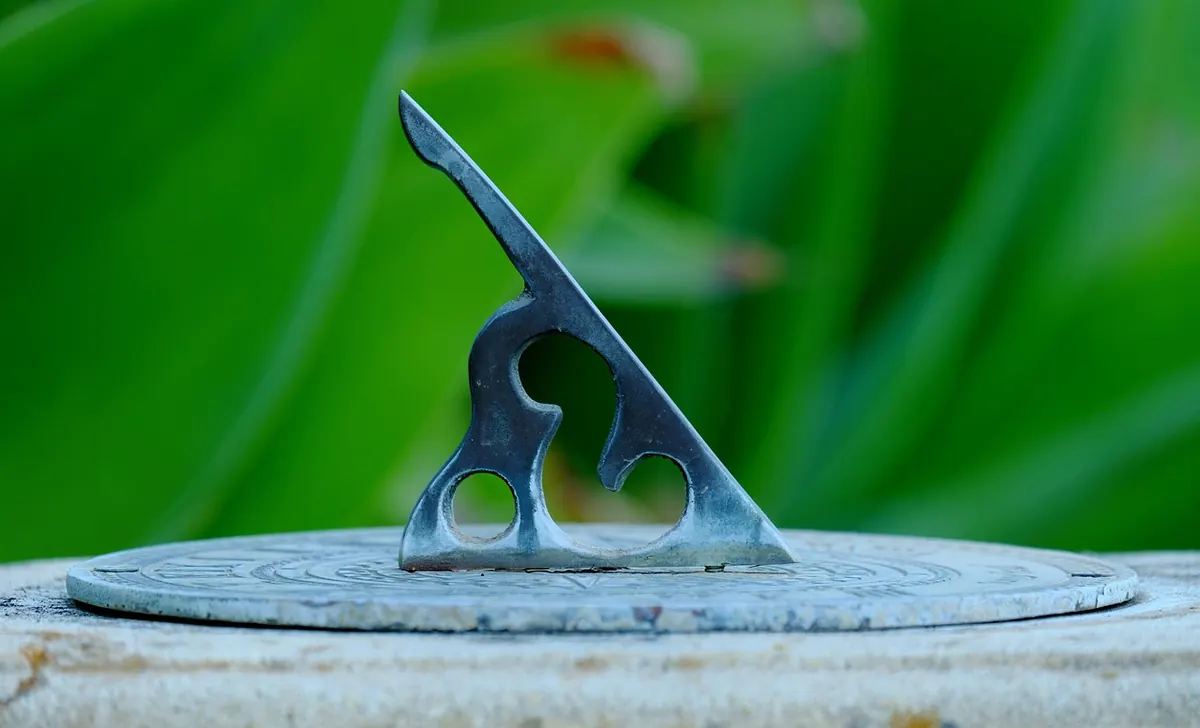
The horizontal dial is the one most people picture. A level plate, a triangular style rising from it at the latitude angle, hour lines fanning out across the surface. The plate sits flat, the style stands in the meridian plane pointing north, and the sun works on it from sunrise to sunset without interruption.
The hour lines are not evenly spaced. At European latitudes they crowd together around noon and spread out towards the ends of the day, so the hour between five and six occupies far more of the plate than the hour between twelve and one. A few practical points:
- Level the plate with real care. A tilt of a degree or two shifts the reading by several minutes, and it will look like a fault in the hour lines.
- Make the plate generous. The shadow of a tall style races off the edge in early morning and late evening.
- Keep the style's thin edge — not its face — in the meridian plane. The shadow you read is cast by the edge.
Horizontal dials suit level ground with an open southern horizon: a garden pedestal, a low plinth, the middle of a lawn. They are easy to site, easy to read while standing, and they work all year. What they cannot absorb is a sloping site pretending to be flat.
Vertical Dials: Working With the Wall You Have
Most historic dials are vertical, because most historic dials are on buildings. The plate is the wall, the style projects from the masonry, and the sun does the rest.
Direct south
This is the simplest vertical case and the one to attempt first. On a wall facing true south, the style lies in the vertical plane perpendicular to the wall and makes an angle of 90° minus your latitude with the face — about 48° out from the wall in Rome. Its elevation above the horizontal is still your latitude, because that rule never bends.
Check the wall with a compass and apply the local magnetic declination, or find true noon from the shadow of a vertical pole. Plenty of walls look south and are not, and a few degrees of error shows up plainly on the finished dial.
Declining and east–west walls
Most walls decline: they face a little east or west of south. The hour lines become asymmetrical and must be calculated for that specific orientation, which usually means a design table or a printed dial face rather than a ruler and protractor. Get the declination wrong and the dial will sit consistently off on one side of noon.
A wall facing due east or due west is a special case. Its plane is parallel to the Earth's axis, so a dial mounted there is really a polar dial and can only show the morning or the afternoon half of the day. North-facing walls in the northern hemisphere catch the sun only early and late in summer, so they are a curiosity rather than a timekeeper.
Polar Dials: Parallel Lines, Six to Six
A polar dial sets its plate parallel to the Earth's axis: tilted at your latitude angle and rising towards the north in the northern hemisphere. The style is a rod carried above the plate on two posts, parallel to both the plate and the axis.
Because the rod, the plate and the axis all run in the same direction, the shadow of the rod is always a straight line parallel to itself, and the hour lines on the plate are parallel too. The spacing widens the further you move from noon, so a polar dial is usually a long narrow rectangle rather than a disc.
The catch is exposure. The plate faces the equinox noon sun, which means it is lit from six in the morning to six in the evening and no more. It cannot show early or late hours. In exchange you get a robust design that works at almost any latitude — at the equator a polar dial is simply a horizontal one — with lines that are easy to lay out and easy to read from an angle.
Equatorial Dials: The Forgiving One
An equatorial dial sets its plate parallel to the equator, tilted at 90° minus your latitude from the horizontal. The style is a rod through the centre, perpendicular to the plate and pointing at the pole. Since the sun moves 15° per hour, the shadow moves 15° per hour across the plate, and the hour lines are all exactly 15° apart. There is no table of unequal angles to get wrong.
Most equatorial dials are double-sided: one face for spring and summer, the other for autumn and winter. Adjustable versions, with the plate hinged to a base and a latitude scale at the side, work anywhere you carry them. The drawbacks are modest. Near the equinoxes the sun's rays skim the plate and the shadow smears, and a small disc can be awkward to read from the side.
Choosing for Your Site and Skill Level
Match the design to what you actually have, not to what looks best in a photograph.
- First build, small garden: equatorial. Fewer calculations, equal hour spacing, and a printed face will get you a working dial in an afternoon.
- Open lawn, traditional look: horizontal. It reads well from standing height and tolerates a wobbly base far less than you would think.
- Only a wall available: vertical, direct south first. Move on to declining walls once you have measured one accurately.
- Teaching, or a narrow ledge: polar. The parallel lines make the geometry visible at a glance.
- A dial that travels: adjustable equatorial with a latitude scale.
Before You Cut Any Wood
Watch the site for a week before you commit. Note which hours the sun actually reaches your spot in March, June and September — a tree that is harmless in winter can swallow the whole afternoon in July.
Then fix true north properly, once, and write the figure down. A compass reading corrected for local declination is fine; the shadow of a vertical pole at true noon is better. Prototype in cardboard or foam board and leave it out for a few days, because a dial that is five minutes out is easier to fix on paper than in stone.
Finally, do not adjust the hour lines to match your wristwatch. A sundial reads apparent solar time, and it will differ from clock time by a quarter of an hour or so through the year, plus an hour in summer if daylight saving applies. That gap is the design working as intended, not an error to be sanded away.
Photo: 1860100 / Pixabay