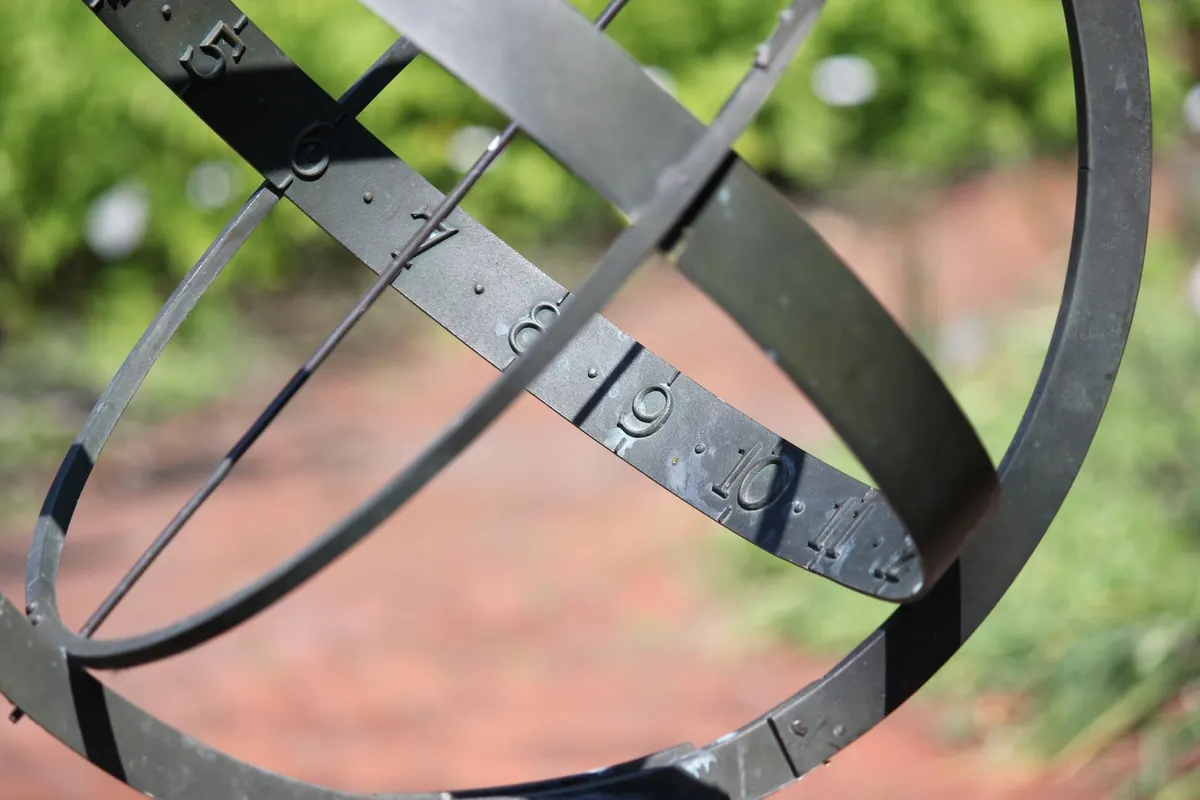


Two dials, one patch of sunlight, and a decision that comes down to less than most buyers expect. The equatorial sundial holds its plate parallel to the equator, tilted to match your latitude, with a rod running through the middle. The horizontal sundial lies flat and level, casting its shadow from a wedge-shaped gnomon cut to your latitude. Both are accurate. Both look good on a stone plinth. Both can be set up correctly by someone who has never owned a sundial before. The differences that matter show up in assembly, alignment, readability, and the modest amount of upkeep each one asks for.
Two Dials, One Geometry
On an equatorial dial the geometry is almost embarrassingly simple. Because the plate sits parallel to the plane of the equator, the sun sweeps across it at a steady fifteen degrees per hour, so every hour line is spaced exactly fifteen degrees apart. The gnomon is a rod perpendicular to that plate, aimed at the celestial pole. Point the rod north, tilt the plate to ninety degrees minus your latitude, and the thing works.
A horizontal dial keeps the plate flat and puts the cleverness into the gnomon instead, which leans toward the pole at an angle equal to your latitude. That single change makes the mathematics visible to anyone who looks. Hour lines are no longer even; they crowd together around midday and stretch apart toward early morning and late afternoon. The effect is stronger at low latitudes and fades as you move toward the poles. Neither design is more correct than the other. They are two ways of flattening the same sphere onto a surface you can read.
One practical consequence of that geometry is worth knowing before you buy. On an equatorial dial, the sun shines on the upper face during the summer half of the year and on the lower face during the winter half. Good equatorial dials are engraved on both sides, or come with markings that work year-round. A single-sided model will simply stop telling the time for months at a stretch, which surprises first-time owners every November.
Assembly Out of the Box
Horizontal dials tend to arrive in three pieces: plate, gnomon, and a small bag of screws. Assembly is usually a five-minute job, and the gnomon often slots into a machined groove so it cannot go in crooked. If your dial is cast in one piece, there is nothing to assemble at all.
Equatorial dials have more going on. A typical model has a base, a hinged or tilting plate, a latitude adjustment with a scale or a set of marked notches, a gnomon that may be removable for transport, and sometimes a built-in spirit level. That is not a fault, but it does mean more screws to check and more than one thing that can be nudged out of position. Before you tighten anything, read the instructions twice and confirm which side of the plate should face up in summer.
Whichever style you choose, put a small spirit level on the base and give it a firm footing. Stone, concrete, or a deep-set post all work. Loose gravel and decking boards that flex underfoot do not.
Alignment: Where Beginners Win or Lose
Both dials need two things: a level base and a line to true north. A magnetic compass points at magnetic north, which differs from true north by an amount that varies with where you live, so do not trust one on its own. The reliable method needs no equipment beyond patience:
- Set the dial roughly in place and check it is level.
- On a sunny morning, mark the tip of the shadow every fifteen minutes or so.
- Find the shortest shadow of the day. That marks local solar noon, and in the northern hemisphere it points along the true north–south line.
- Rotate the dial until its noon line lies along that mark, then check the level again and fix it down.
This is where the two styles genuinely diverge. The horizontal dial is aligned once and then forgotten. Its latitude angle lives in the shape of the gnomon, so if you bought the version cut for your region, there is nothing to adjust and nothing to get wrong. The equatorial dial is more adjustable, which is both its virtue and its trap. You can tilt the plate and rotate it about its axis, so you can correct for longitude and, if you like, for the difference between sundial time and clock time. But every one of those adjustments is another thing that can drift when the dial is knocked, and each one affects the reading differently. If you enjoy adjusting and testing, that is a pleasure. If you want to bolt something down and never think about it again, it is a chore.
Reading the Time in Real Conditions
Equatorial dials read beautifully. Even spacing means the numerals never collide, and because the shadow moves at a constant rate, the gap between one hour and the next always looks the same. Near the equinoxes, though, the sun's rays strike the plate at a shallow angle, and the shadow turns long, soft, and less precise at the edges.
Horizontal dials are easier to read at a glance from standing height, which is what most people actually do. They are also fussier in the details. Numeral engraving gets tight around midday, where the lines bunch up, while the outer hours sit far apart and often run off the edge of small plates. Near sunrise and sunset the shadow is so long and raking that the reading becomes guesswork. A well-made dial solves this with clean, engraved lines rather than printed ones; a cheap one does not, and you will notice the difference in low sun.
Whichever dial you own, remember that it shows apparent solar time. Comparing it with a wristwatch requires two corrections: one for your distance from the centre of your time zone, and one for the equation of time, which swings by roughly a quarter of an hour either way across the year. Many equatorial dials include a graph or a rotating ring to handle this. Horizontal dials usually do not, so expect a small seasonal difference and enjoy it rather than fight it.
Weather, Wear, and Upkeep
A flat plate is a small table for the sky. Rain pools on it, leaves collect in the corners, birds use it, and snow sits on it for days. That does not damage good brass or aluminium, but it does mean an occasional wipe with a soft cloth and, in a garden, a check after storms. A tilted equatorial plate sheds water far better and stays cleaner through the year.
Moving parts are the other consideration. Equatorial dials have screws and hinges that can loosen in wind or after a winter of frost, and the plate can shift a degree without any visible change. Check the level and the north line each spring. Horizontal dials have almost nothing to go wrong, though frost heave under a plinth can tilt them slowly, and a single nudge from a lawnmower is enough to spoil the alignment.
Whatever the style, re-check alignment after any move, after building work, and once a year as a habit. It takes five minutes and saves months of slightly wrong readings.
A Simple Way to Decide
If you want one piece of advice to carry into the shop, it is this. Choose the horizontal dial if you want simplicity: fewer parts, nothing to adjust, a single alignment and then years of quiet service, and a face you can read from a few steps away. Choose the equatorial dial if you enjoy the mechanics, want even spacing and steady precision, and are happy to check a couple of settings each season and read the lower face in winter.
Then look at where it will stand. A windy, exposed spot favours the low profile of a horizontal dial. A shady corner that gets only a few hours of direct sun suits neither, so find the brightest spot first. And if you are buying for someone else, remember that an equatorial dial is more interesting to own while a horizontal dial is more forgiving to live with. Both will tell you the time honestly, once you have given them a true north line and a firm footing.
Photo: karosieben / Pixabay