
A sundial is honest. It reports the sun’s position, not the agreement we have made with our clocks. That honesty becomes obvious twice a year, when daylight saving time shifts the civil clock by an hour and the dial seems to disagree with everything else in the house. The good news is that you do not need to move the dial, redraw its hour lines, or wait six months to trust it again. With two small corrections—one for daylight saving, one for the seasonal wobble of solar time—you can read a sundial accurately on any clear day.
What a Sundial Really Reads
Most simple sundials show local apparent solar time. Noon on the dial is the moment the sun crosses your local meridian, the imaginary line that runs from due south to due north across your sky. That is not the same as noon on your phone. Clock time is a human convention: it averages the sun’s motion, groups regions into time zones, and then, during daylight saving, adds another hour for convenience.
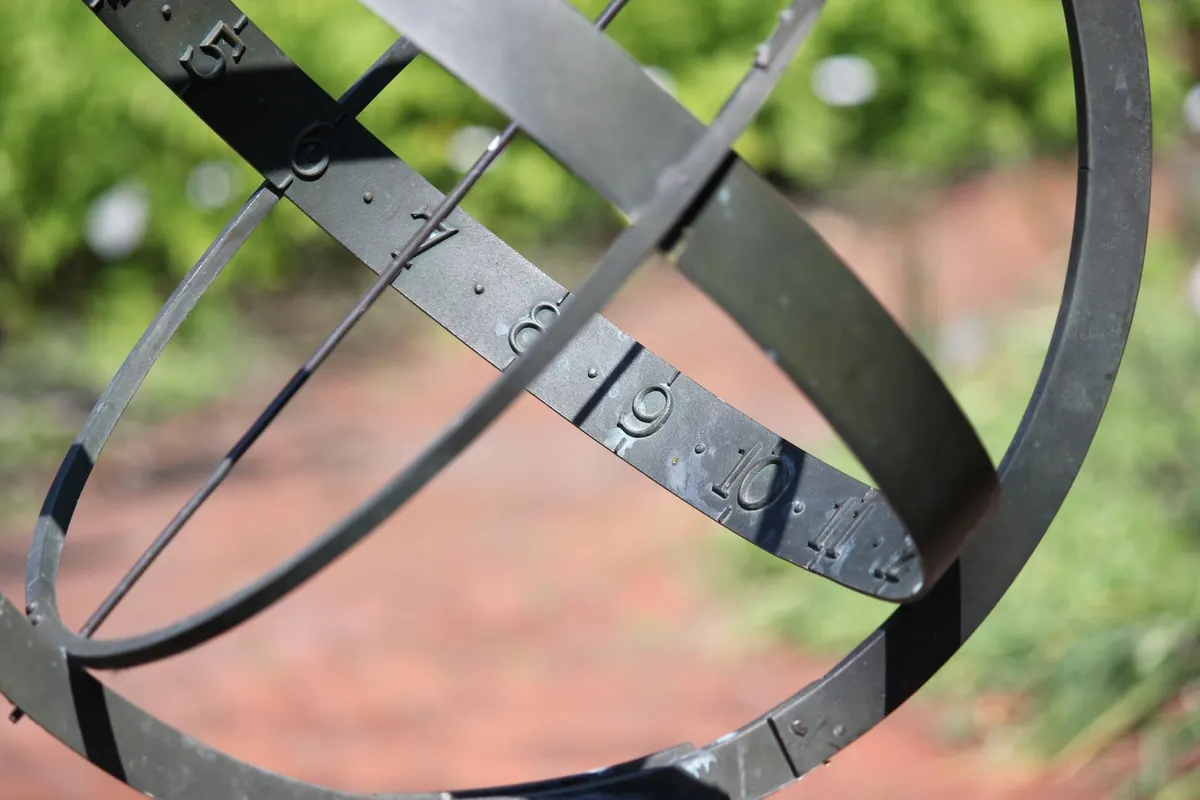
Before adjusting anything, look at the dial itself. Some dials are plain hour-angle instruments. Others include a table, a graph, or an analemma—a figure-eight curve—that lets you correct for the equation of time. A few are marked for daylight saving directly, often with a second set of numerals. Read the maker’s markings first. If the dial already accounts for a correction, applying it again will only confuse the result.
The Daylight Saving Adjustment: One Hour, Applied Last
Daylight saving time is the easiest correction to understand. When clocks are set one hour ahead of standard time, your civil clock reads one hour later than it would otherwise. A dial that reads 3:00 in solar time corresponds to 4:00 on a daylight-saving clock, assuming no other corrections. In autumn, when clocks fall back, that hour disappears again.
Apply this correction last. Get the dial reading as close to standard time as you can, then add the hour if daylight saving is in force. This order matters because the other corrections are measured in minutes, and it is easy to lose track of whether you have already added sixty of them. If your region does not observe daylight saving, skip this step entirely. If you travel with a portable dial, check the local rules rather than assuming the dates match home.
Seasonal Variation: The Equation of Time
The sun is not a perfect timekeeper. Earth’s orbit is slightly elliptical, and its axis is tilted, so apparent solar time runs ahead of mean solar time at some points in the year and behind at others. The difference is called the equation of time. It is not a clock error and not a flaw in the dial; it is the geometry of the solar system showing up in minutes.
Across the year the correction reaches roughly a quarter of an hour in either direction. In early November the sun runs fast, and a simple dial may be about sixteen minutes ahead of mean time. In mid-February it runs slow, and the dial may be around fourteen minutes behind. These are not failures of the dial. They are the reason old sundials often carry a small table of months and minutes.
Use the equation of time as a correction to the dial reading, not to the sundial’s physical position. If a reliable table says the dial is fast, subtract those minutes. If it says the dial is slow, add them. Many dials include a graph engraved beside the hour lines; find the current date along the graph, read the minutes, and apply the sign shown. If your dial has no such table, a printed equation-of-time table or a respected almanac will do. The key is to use the correction once, from a source you trust.
Longitude, Standard Time, and Your Dial’s Label
There is one more correction to check: longitude. Time zones are built around standard meridians, but your dial sits at your actual longitude. The sun reaches your meridian at a different moment than it reaches the standard meridian. The difference is about four minutes for every degree of longitude.
If you are west of the standard meridian, local solar noon arrives later, so add four minutes per degree. If you are east, subtract four minutes per degree. A dial engraved for local solar time needs this correction if you want standard clock time. A dial engraved for a standard meridian may already include it. Again, the dial’s label or design should tell you which case applies.
A Worked Reading, Step by Step
Suppose your dial reads 2:40 on a sunny afternoon. The equation-of-time table says the sun is six minutes fast, so the dial is ahead of mean time. You are three degrees west of your standard meridian, and daylight saving is in force. Here is the sequence:
- Start with the dial: 2:40 local apparent solar time.
- Correct for the seasonal difference: subtract six minutes because the dial is fast. That gives 2:34 mean local time.
- Correct for longitude: three degrees west means add twelve minutes. That gives 2:46 standard time.
- Add daylight saving: add one hour. The clock time is 3:46.
Your own numbers will differ, and that is the point. The routine stays the same: dial reading, seasonal correction, longitude correction, daylight saving. Write the sequence on a small card and keep it with your garden notes. After a few sunny afternoons the arithmetic becomes quick, and the dial stops feeling like a museum piece.
Reading the Shadow Without Guesswork
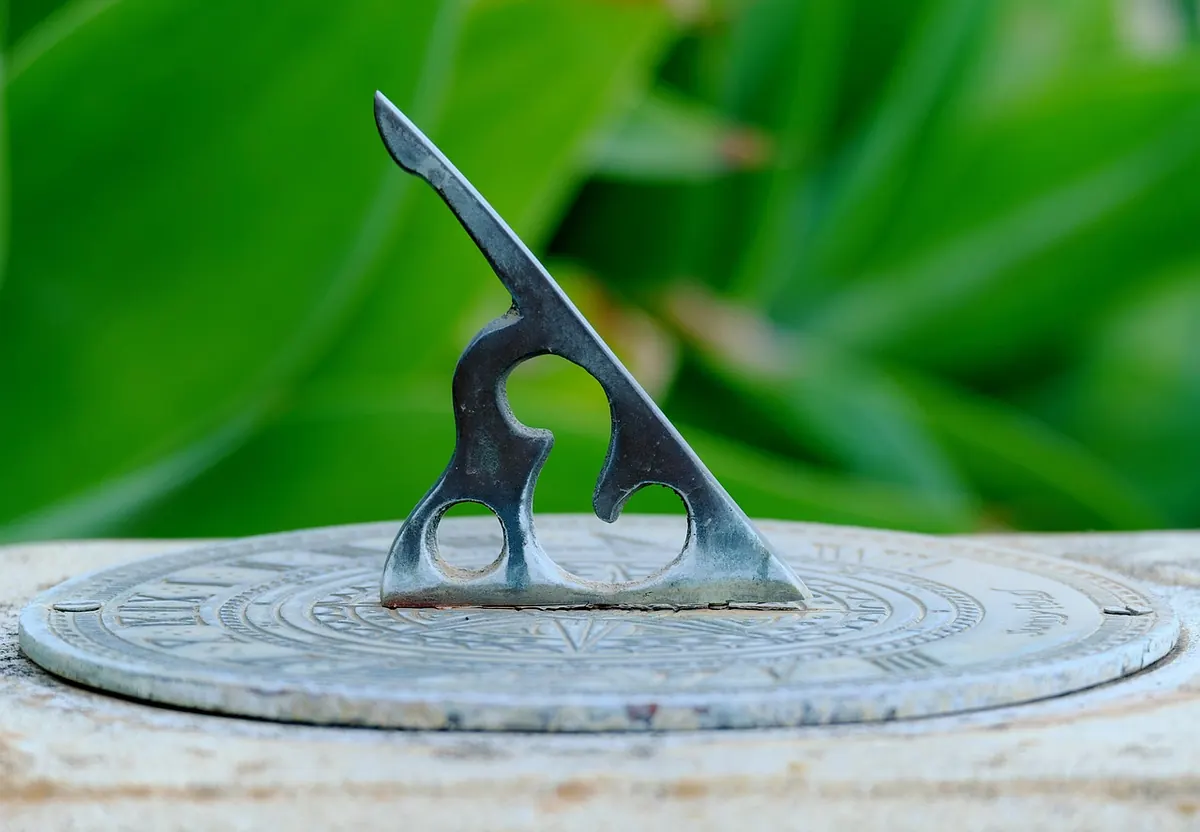
A correction is only as good as the reading beneath it. Stand so that the shadow’s edge is crisp and unobstructed. Use the straight edge of the gnomon, not the blurry penumbra around it. If the dial has minute marks, read to the nearest minute; if it has only hour lines, estimate carefully and accept that your result is approximate.
Watch for nearby walls, trees, or buildings that cast their own shadows across the dial. A sundial does not need full sun all day, but it does need an open view of the sun at the moment you read it. Also check that the dial is properly oriented. A dial designed for true north will not read correctly if it has been nudged sideways or mounted on a wall that faces the wrong direction. The hour lines may be curved; follow the shadow, not the nearest numeral you happen to like.
Your Practical Closing Routine
Keep the dial where it is. Note the shadow reading, apply the equation-of-time correction for the date, add or subtract the longitude minutes if your dial requires them, and finish with the daylight saving hour when it applies. If the dial has its own correction table, use that first and do not double-correct. On a day when the equation of time is near zero, the arithmetic is especially easy—good practice for learning the routine. With a little repetition, reading a sundial in daylight saving time becomes a quiet, reliable habit rather than a seasonal puzzle.
Photo: 1860100 / Pixabay